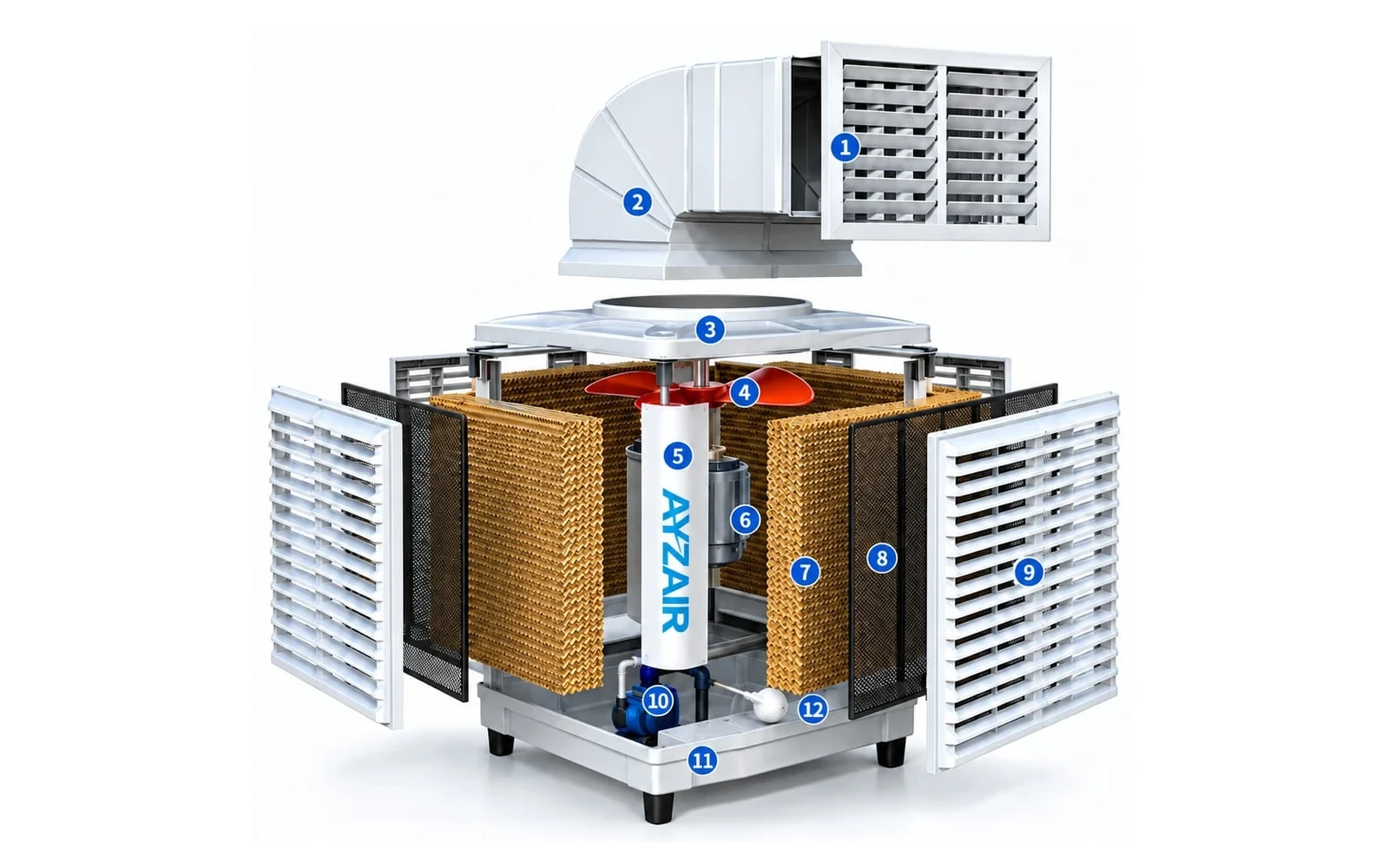
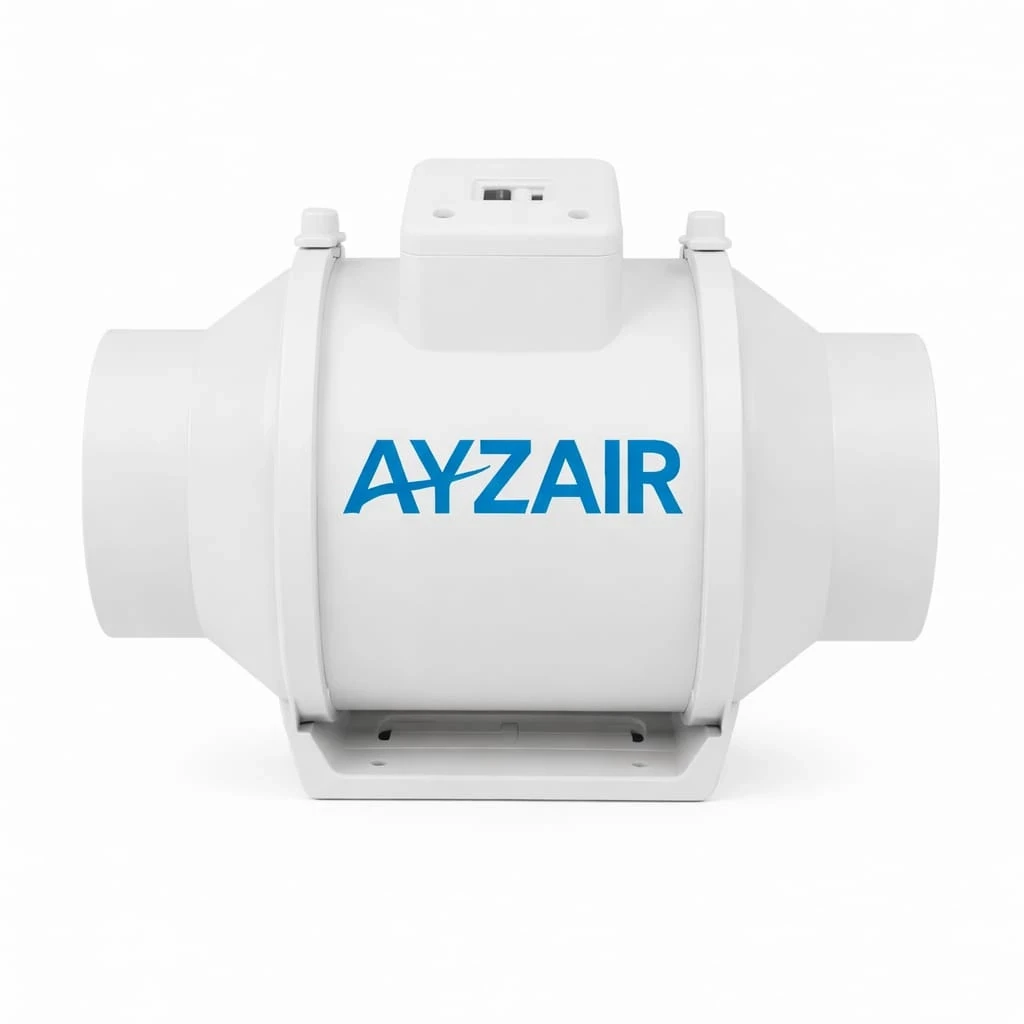
Evaporative cooling is the cheapest real cooling there is. Air is drawn through a water-saturated pad, the water evaporates, and evaporation takes heat out of the airstream. No compressor, no refrigerant, a fraction of the running cost of air conditioning, and the air arriving is fresh rather than recirculated.
It has one hard limit, and it is worth settling before any discussion of models. Evaporation needs the incoming air to be dry enough to accept more moisture. In dry heat the effect is dramatic. In humid heat there is very little the air can absorb, and the cooler delivers a small temperature drop and a lot of added humidity, which usually feels worse rather than better.
First question: will evaporative cooling work where you are?
The number that governs it is relative humidity on a hot afternoon, not the annual average. Below about 40 per cent, evaporative cooling is excellent and will routinely drop supply air by 8 to 12 °C. Between 40 and 60 per cent it still earns its place. Above about 70 per cent the temperature drop is small and the added moisture is unwelcome.
This is why we will tell a buyer in Jakarta, Lagos, Dhaka, Singapore or coastal Malaysia that our coolers are not the right product, and point them at air movement and extraction instead. It is also why the same product is close to ideal in Pune in April, in Rajasthan, in Riyadh, in Muscat in winter or across most of inland Australia.
If you are not sure which side of the line your site falls on, look up the typical afternoon humidity in your hottest month. One number settles it.
| Afternoon humidity | Typical temperature drop | Verdict |
|---|---|---|
| Under 30% | 10–15 °C | Excellent |
| 30–45% | 8–12 °C | Very good |
| 45–60% | 5–8 °C | Worthwhile |
| 60–70% | 3–5 °C | Marginal |
| Over 70% | 1–3 °C, air feels damp | Use fans and extraction instead |
← Swipe the table sideways to see all columns
What a portable cooler is actually for
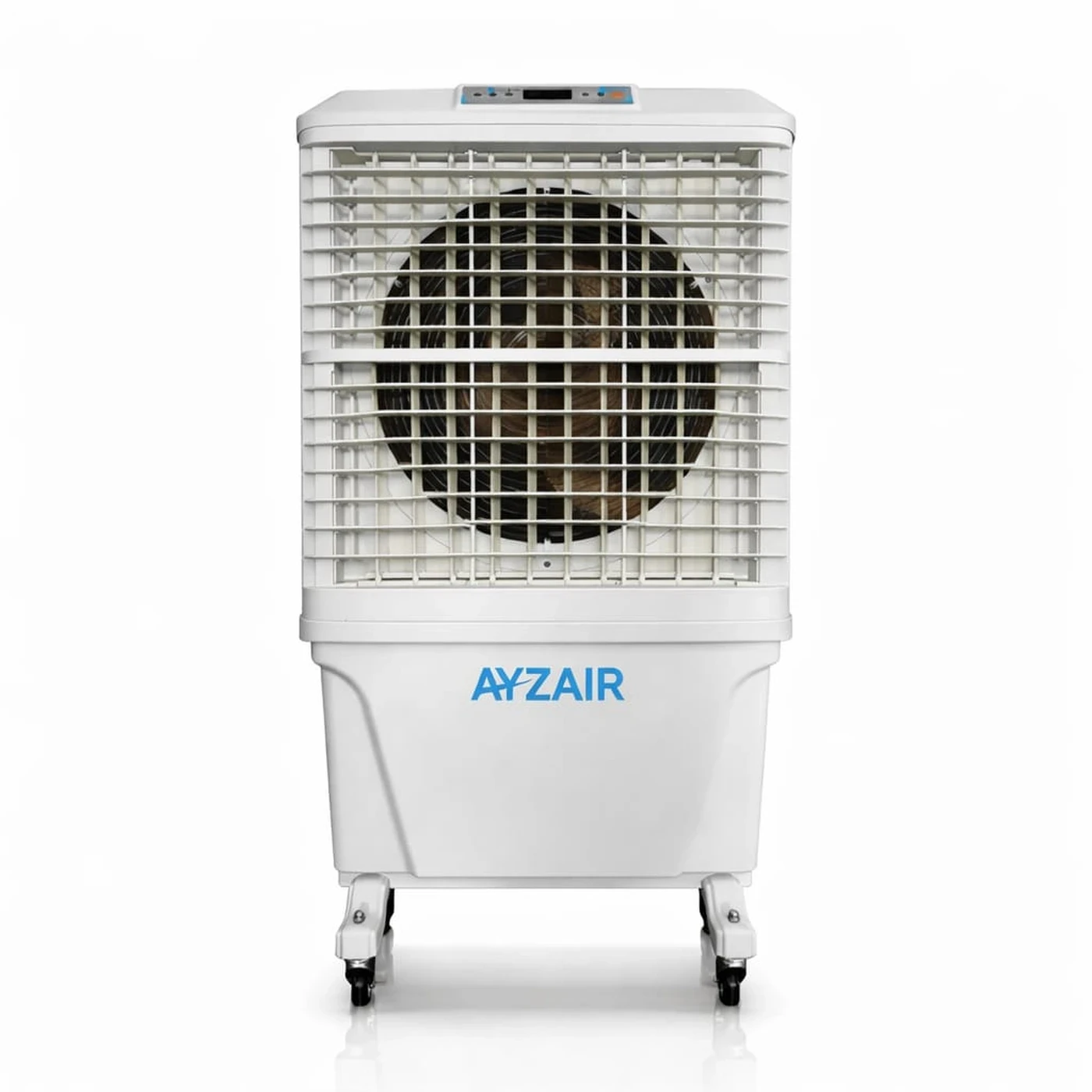
A portable unit carries its own water. The TENT-150 holds 150 litres, delivers 16,000 m³/h and covers roughly 1,000 square feet. It plugs into an ordinary socket, rolls to where it is needed, and requires no installation, no ducting and no plumbing.
That makes it the right choice for exactly the situations a fixed cooler cannot serve. Outdoor and semi-outdoor events under canvas. A loading bay or open-sided shed. A workshop corner that is only a problem in April and May. A rented unit where nothing may be fixed to the building. A site where the cooling has to follow the work rather than the other way around.
The trade-off is the tank. 150 litres is a working day in dry heat and rather less at peak, so somebody has to refill it. If nobody owns that job, the cooler stops working by mid-afternoon and the purchase is blamed rather than the routine.
What a ducted cooler does that a portable cannot
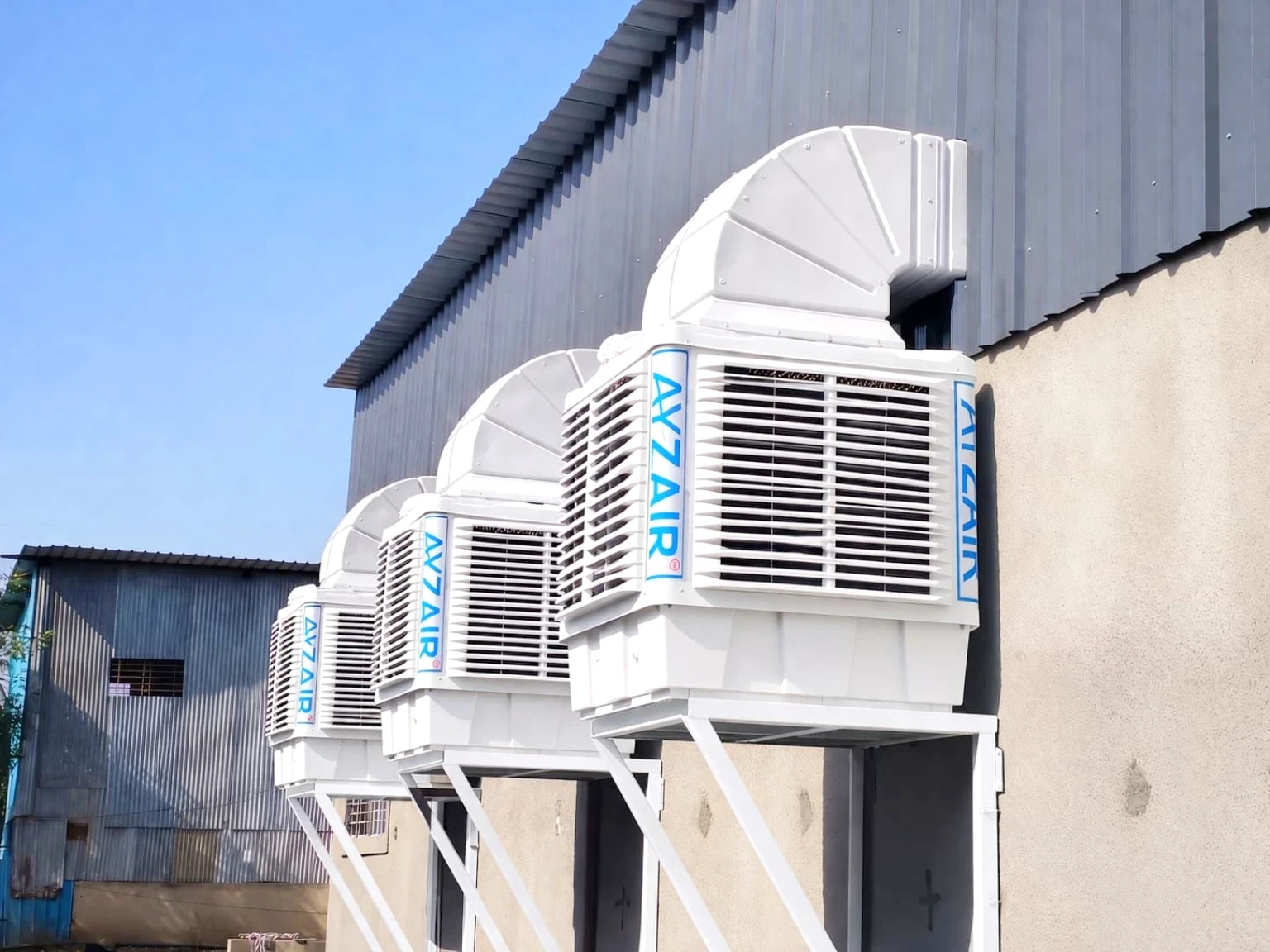
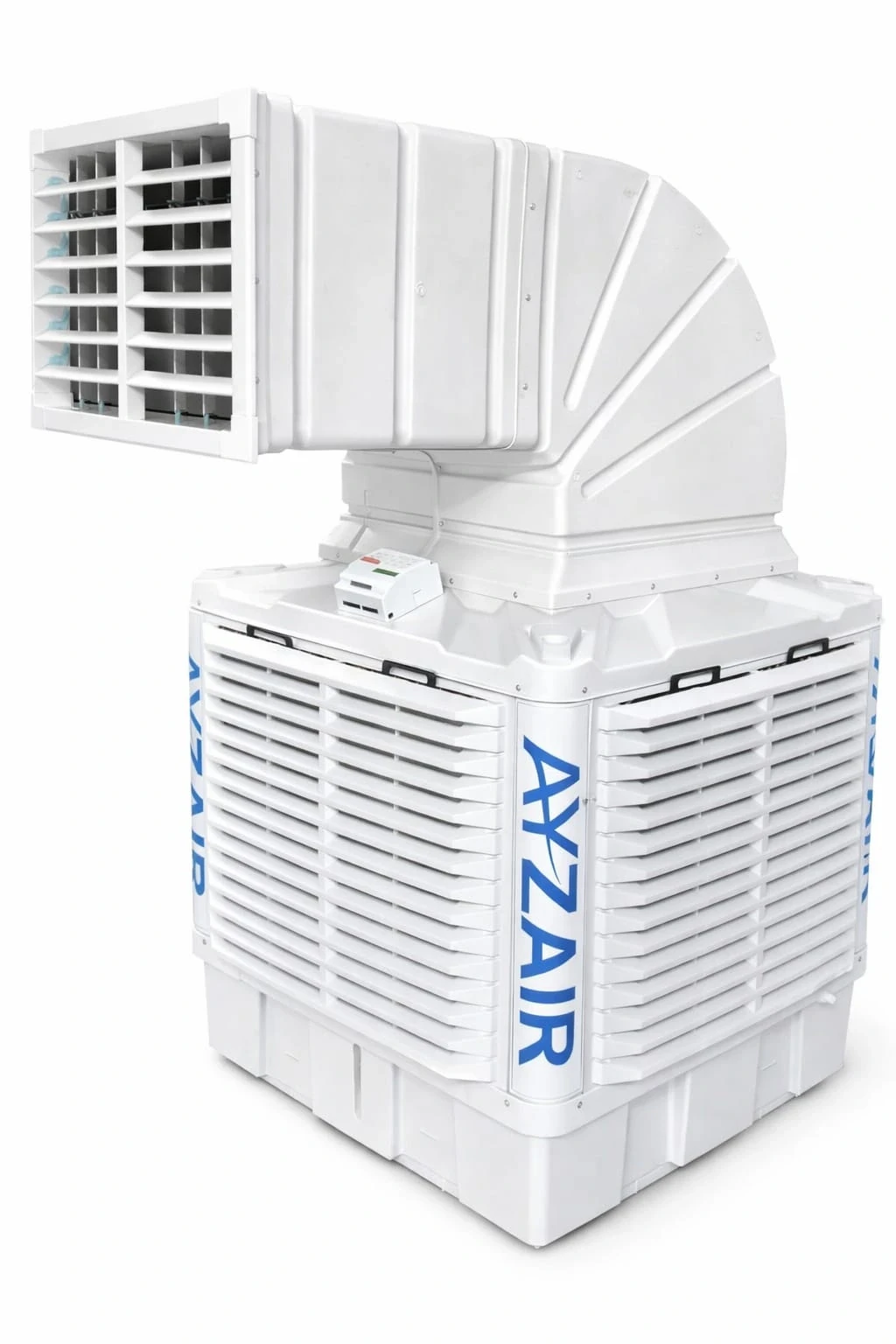
A duct cooler is mounted outside the building — on the wall or the roof — and ducts cooled air inside. The range runs from 18,000 to 30,000 m³/h per unit, with plumbed water so nothing needs refilling, and a single-unit duct run of up to 20 metres.
Mounting outside is the real advantage, and it is often misunderstood. The cooler draws fresh outside air, cools it, and pushes it in; stale air, heat, fumes and dust leave through doors and vents. The building gets a continuous change of fresh air rather than the same air recirculated. Nothing takes up floor space, and the noise source is outside the working area.
Ducted also wins on scale and on running cost per square metre. Covering a 10,000 square foot shop floor with portables means ten units and ten tanks to fill; two or three duct coolers do the same work with a water line and no daily routine.
| Portable (TENT-150) | Duct cooler (AYZAIR-18 to 30) | |
|---|---|---|
| Air delivery | 16,000 m³/h | 18,000–30,000 m³/h |
| Coverage | about 1,000 sq ft | 2,000–4,000 sq ft per unit |
| Water | 150 L tank, refilled by hand | Plumbed, automatic |
| Installation | None — plug in | Wall or roof mount, ducting |
| Moves between jobs | Yes | No |
| Floor space used | Yes | None — mounted outside |
| Best for | Events, bays, seasonal, rented | Permanent shop floors |
← Swipe the table sideways to see all columns
Getting the exhaust path right, either way
Evaporative cooling is an open system, and this is the part most often got wrong. It pushes a continuous volume of fresh cooled air in, so an equal volume of warm stale air has to leave. In a sealed building the pressure builds, the airflow drops and the cooling effect falls away.
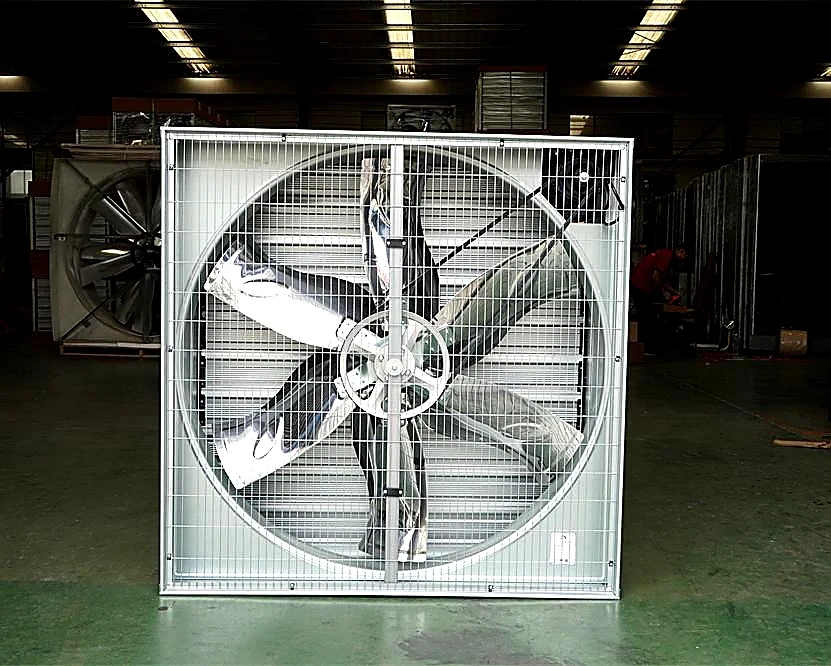
The fix is simple and costs nothing on a new installation: leave openings on the far side from the cooler. Doors, high-level louvres, roof vents or wall extract fans — anything that lets the displaced air out at the opposite end of the space, so the cooled air sweeps across the floor on its way rather than stalling.
As a rule, allow roughly the same free opening area for exhaust as the inlet rule for extract systems: about one square metre per 11,000 m³/h being pushed in. A pair of 30,000 m³/h duct coolers needs something in the order of five and a half square metres of free opening, not a cracked window.
Tell us your climate and we will tell you honestly
Send your city, the floor area and the clear height. If evaporative cooling suits your air we will size it. If it does not, we will say so and recommend air movement or extraction instead — including when that means a smaller order for us.
Get an honest recommendation