

Skip to content
Ayzair

India coverage

Built in Pune. Installed across India.

Our factory is at Chakan and our office at Bhosari I.E. From there we supply factories, warehouses, poultry farms, kitchens and halls across every major Indian industrial belt. Pick your city for the local climate case and the industrial areas we already serve.
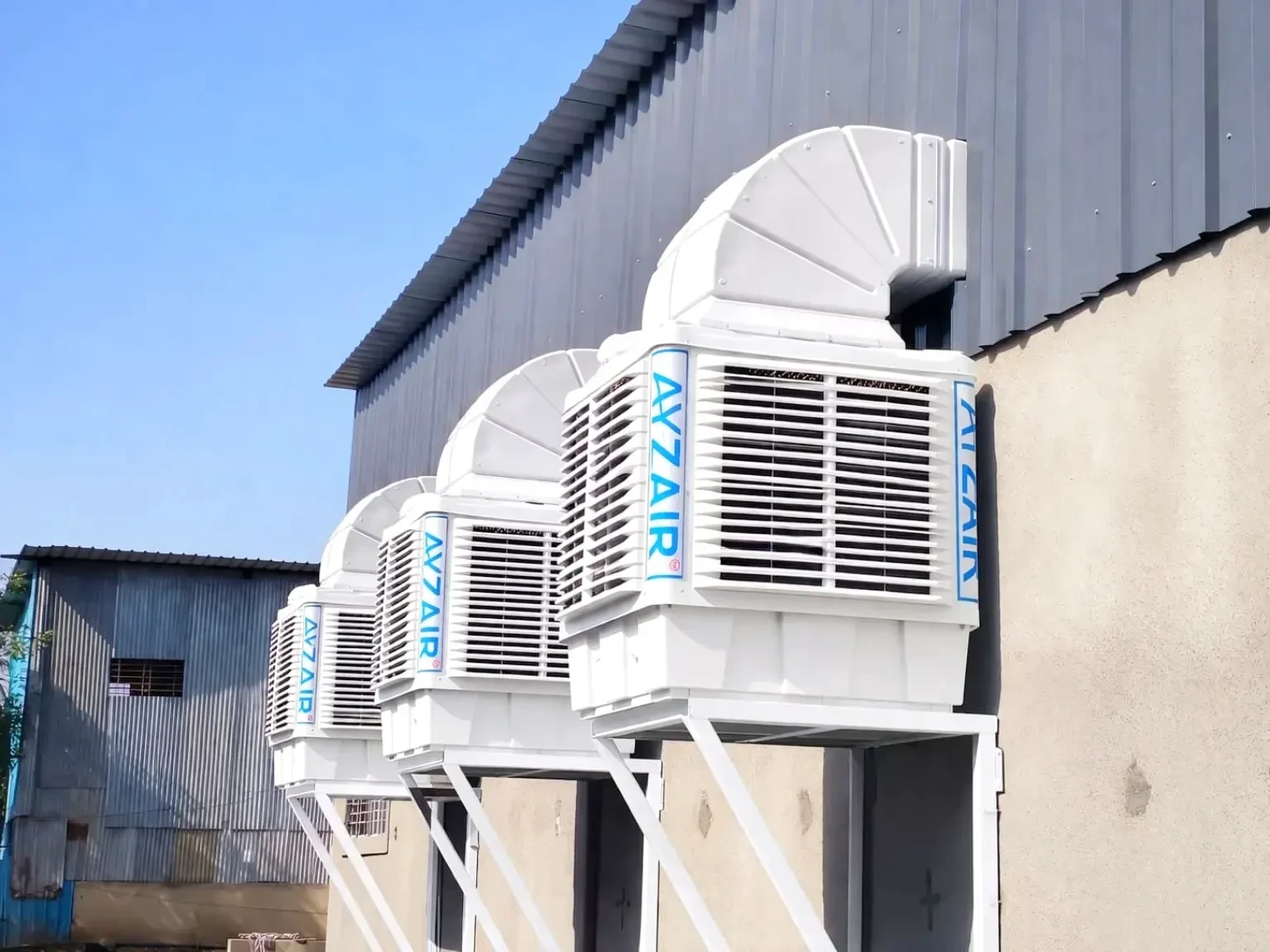
Ayzair industrial air coolers installed on a factory in Pune, India

Pune

Maharashtra

38–42 °C, low humidity March–June

Pune is our home market — our office is in Bhosari I.E. and our manufacturing facility is at Chakan. That means same-week site visits, direct factory pickup, and service engineers who can reach your plant the same day across PCMC, Chakan, Talegaon, Ranjangaon and Hinjewadi.

Bhosari MIDCChakan MIDCTalegaon MIDC+5 more

Mumbai

Maharashtra

33–36 °C with high coastal humidity

Mumbai is coastal and humid, so we are honest about the mix: HVLS fans and exhaust ventilation carry most of the comfort load here, with evaporative cooling suited to the drier months and to fresh-air makeup in kitchens and workshops. Bhiwandi and Panvel warehousing is one of our strongest Mumbai-region applications.

BhiwandiTaloja MIDCNavi Mumbai & JNPT belt+4 more

Nashik

Maharashtra

38–41 °C, dry — excellent evaporative conditions

Nashik combines dry summer heat with a dense industrial base at Satpur and Ambad MIDC, plus a large agriculture, poultry and viticulture sector. The dry-heat profile means evaporative cooling performs at the top of its range here.

Satpur MIDCAmbad MIDCSinnar MIDC+3 more

Ahmedabad

Gujarat

42–46 °C, very low humidity — outstanding evaporative conditions

Ahmedabad and the wider Gujarat industrial belt see some of the highest dry-bulb temperatures in India with very low humidity — conditions in which evaporative cooling performs at its best. Textile mills, chemical plants and the Sanand automotive cluster are core applications.

Vatva GIDCNaroda GIDCChangodar+3 more

Delhi NCR

Delhi · Haryana · Uttar Pradesh

43–47 °C, very dry May–June

The NCR industrial belt runs through some of India’s hottest, driest summer conditions. Gurugram and Manesar automotive, Noida electronics and Bahadurgarh warehousing all face 45 °C-plus shop floors where refrigeration is simply not viable at that volume.

Manesar IMTGurugram Udyog ViharNoida & Greater Noida+4 more

Chennai

Tamil Nadu

38–42 °C with high coastal humidity

Chennai is hot and humid, so HVLS fans and exhaust ventilation do most of the work. The Sriperumbudur–Oragadam automotive corridor and Ambattur engineering estate are large HVLS installations where 1,200 m² per fan changes the economics entirely.

SriperumbudurOragadamAmbattur Industrial Estate+3 more

Hyderabad

Telangana

40–44 °C, dry April–June

Telangana pairs a dry summer that suits evaporative cooling with one of India’s largest poultry sectors. Hyderabad’s pharma and engineering estates and the state’s broiler and layer farms are both core Ayzair applications.

JeedimetlaBalanagarPatancheru+4 more

Bengaluru

Karnataka

33–37 °C, moderate humidity

Bengaluru’s milder climate shifts the emphasis: buildings here need air movement and fresh-air exchange more than aggressive cooling. HVLS fans in warehouses, gyms and manufacturing units deliver comfort at very low running cost, and exhaust ventilation handles process heat.

Peenya Industrial AreaBommasandraJigani+4 more

Ludhiana

Punjab

42–46 °C, dry May–June

Punjab’s industrial belt runs hosiery, textile, bicycle-component and forging units in extreme dry summer heat, alongside a large dairy and poultry sector. Both are strong evaporative cooling conditions.

Focal Point LudhianaJalandharMandi Gobindgarh+3 more

Coimbatore

Tamil Nadu

35–39 °C, moderate humidity, drier than coastal Tamil Nadu

Coimbatore and Tiruppur run textile mills, foundries and pump manufacturing where process heat, cotton dust and fumes all need moving. The inland location is drier than Chennai, so evaporative cooling works usefully alongside HVLS and exhaust ventilation.

TiruppurSIDCO KurichiPeelamedu+3 more

Jaipur

Rajasthan

44–48 °C, extremely dry — the best evaporative conditions in India

Rajasthan gives evaporative cooling its best conditions anywhere in India: 46 °C at 12–18% relative humidity produces temperature drops of 14 °C or more. Bhiwadi, Neemrana and Sitapura industrial areas are core markets.

SitapuraBhiwadiNeemrana+3 more

Indore

Madhya Pradesh

40–43 °C, dry April–June

The Indore–Pithampur–Dewas industrial corridor is central India’s strongest manufacturing cluster, running automotive, pharma and food processing in dry summer heat that suits evaporative cooling well.

PithampurDewasSanwer Road+3 more

Agra

Uttar Pradesh

44–46 °C, bone dry May–June

Agra carries India’s largest leather footwear cluster along with a long-established foundry and iron castings trade, and both keep people working close to heat through the worst months of the year. May and June air here sits at 44–46 °C with relative humidity often in single figures, which is close to the textbook condition for evaporative cooling. Lasting rooms, sole-pressing lines and moulding bays all gain a large temperature drop for roughly 2 kW per cooler.

Sikandra Industrial AreaRunaktaEPIP Shastripuram+4 more

Aligarh

Uttar Pradesh

43–45 °C, dry April–June

Aligarh is the lock and builders-hardware capital of the country, and most of the making happens in compact workshops running brass and zinc die-casting, buffing and electroplating lines. That changes what we quote: a single mobile industrial floor fan over a casting bench, or one or two TENT-150 portable coolers, often makes more sense than a ducted installation. Larger hardware plants and export units on Ramghat Road do take ductable coolers, and plating shops almost always need extraction before anything else.

Talanagri Industrial AreaUPSIDC Industrial AreaRamghat Road belt+3 more

Prayagraj (Allahabad)

Uttar Pradesh

42–45 °C and dry until late June, then humid through the monsoon

Prayagraj works in two seasons rather than one. Through April, May and June the air is fiercely hot and dry, which is when ductable evaporative coolers do their best work in glass units, wire and cable shops and food processing halls around Naini. Once the monsoon arrives in July the humidity climbs and the honest answer changes to air movement and extraction, so we usually specify HVLS fans and hammer exhaust fans alongside the coolers so a plant is covered right through the year.

Naini Industrial AreaIFFCO Phulpur beltJhunsi+3 more

Amritsar

Punjab

42–44 °C, dry May–June

Amritsar mixes old trades and new freight. Shawl and textile weaving units, rice and flour mills, food processing plants and machine tool shops all run through a May and June that is hot and notably dry, so a wet pad here still gives a wide wet-bulb depression. Rice mills and grain handling add dust and husk to the picture, which is why extraction usually goes in with the cooling rather than after it.

Focal Point Industrial EstateExtension Focal Point, Mehta RoadVallah+4 more

Amroha

Uttar Pradesh

43–45 °C, dry mid-April to late June

Amroha is a small market and we would rather say so than pretend otherwise. The town is known for dholak and musical instrument making, handloom weaving, handicrafts, mango handling and sugar processing, and most of that happens in modest sheds and family workshops rather than large plants. What fits here is one TENT-150 portable cooler for an open shed, a Model 1500 mobile fan rolled to wherever the work is that week, or a couple of wall-mounted exhaust fans — and we are happy to quote single units.

Amroha town workshop clusterGajraula industrial beltHasanpur+3 more

Bhopal

Madhya Pradesh

40–43 °C, dry April–June

The BHEL complex gave Bhopal shop floors on a scale few Indian cities have — bays hundreds of metres long under roofs high enough that ordinary fans never reach the working level. That is exactly what a 20 ft or 24 ft HVLS fan is built for, covering around 1,200 m² each and leaving the aisles clear of pedestal fans. Around it, Govindpura and Mandideep run pharma, packaging and component plants where dry April-to-June heat makes ductable evaporative cooling an easy addition.

Govindpura Industrial AreaMandideep Industrial AreaBHEL Bhopal complex+4 more

Chandigarh

Chandigarh & Tricity

41–44 °C, dry May–June before the monsoon

The Tricity buying area is wider than the city itself. Industrial Area Phase I and II hold light engineering and printing units, Mohali adds pharma, auto ancillaries and IT campuses, Panchkula runs its own industrial belt, and Baddi-Barotiwala sits an hour away with one of India’s densest pharmaceutical clusters. Pre-monsoon heat is dry enough for ductable coolers to work well, while pharma and clean-adjacent areas usually want HVLS fans and controlled extraction instead of added moisture.

Industrial Area Phase IIndustrial Area Phase IIMohali Phase VIII & IX+4 more

Dhanbad

Jharkhand

42–45 °C, dry and dust-laden in May and June

Dhanbad sits on the Jharia coalfield, and the air here carries more than heat. Washeries, coke ovens, crushers, cement grinding and the Sindri fertiliser belt all generate hot dust-laden conditions where heat extraction matters more than a few degrees of supply air temperature, so we lead with large hammer exhaust fans and HVLS fans in the maintenance and fabrication sheds. Evaporative coolers do work in the dry pre-monsoon weeks, but we will tell you plainly that pads and filters clog faster in coal dust and need washing on a short cycle rather than a seasonal one.

Sindri industrial beltGovindpurNirsa+4 more

Faridabad

Haryana

43–45 °C, very dry May–June

Faridabad is one of the older engineering towns of the NCR and still one of the densest, with forging shops, auto-component lines, tractor assembly and refrigeration manufacturing packed into the sector industrial areas along Mathura Road. Peak summer air is hot and very dry, so ductable coolers deliver a genuine drop at the working level, and press shops and heat-treatment bays need extraction on top of it rather than instead of it.

Sector 6 Industrial AreaSectors 24 & 25Sector 31+4 more

Firozabad

Uttar Pradesh

44–46 °C outdoors, far higher beside a working tank furnace

Firozabad makes most of the country’s glass bangles, and the men working a metre from a tank furnace face some of the hardest thermal conditions in Indian industry. Cooling the whole building is not the goal here. The workable answer is a three-part one: large-diameter hammer exhaust fans set high to pull furnace heat straight out of the roof zone, ductable evaporative coolers supplying cooled make-up air to the operator positions so the extracted air is replaced with something breathable, and HVLS fans over the joining, decorating and packing halls where the load is steady rather than radiant.

Firozabad glass clusterUPSIDC Industrial Area FirozabadMakkhanpur Road belt+4 more

Gurugram (Gurgaon)

Haryana

44–46 °C, very dry May–June

Gurugram works on two scales at once. There is the Maruti Suzuki and tier-one component ecosystem in Manesar and Udyog Vihar, where press shops, paint support areas and assembly lines need both cooled air and extraction, and there is the warehousing corridor running out along NH-48 and Pataudi Road, where clear-height sheds are natural HVLS territory. Peak summer air is hot and exceptionally dry, so evaporative cooling reaches nearly its full range here, and data centre and office sites take inline duct fans for balanced ventilation instead.

IMT ManesarUdyog Vihar Phase I–VSector 37 Pace City+4 more

Guwahati

Assam

33–36 °C with very high humidity from April through September

We will be straight about Guwahati: this is not evaporative cooling country. The air over the Brahmaputra valley is already close to saturated for much of the year, so a wet pad has almost no wet-bulb depression to work with and would add moisture where moisture is already the problem. The right answer for tea factories, plywood and food units, cement handling and the big distribution sheds that feed all eight North East states is HVLS fans for continuous air movement over people and stock, with hammer exhaust fans pulling out process heat, drier exhaust and damp stale air.

Amingaon Industrial EstateBrahmaputra Industrial Park, SilaBamunimaidam Industrial Estate+4 more

Gwalior

Madhya Pradesh

43–45 °C, dry April–June

Gwalior inherited a manufacturing habit from the JC Mills textile era and has kept it going through the Malanpur and Banmore estates, which now run auto components, ceramics, food processing and packaging. Summers in this stretch of the Chambal region are hot and genuinely dry, so a ductable evaporative cooler pulls supply air down by a wide margin for about 2 kW, and high-bay assembly and storage bays take HVLS fans to spread that air where it is needed.

Malanpur Industrial AreaBanmore Industrial AreaSitholi Industrial Area+3 more

Hubballi-Dharwad

Karnataka

38–40 °C, dry March–May on the Deccan plateau

North Karnataka’s trade and manufacturing capital runs machine tools, foundries and food processing alongside the Tata Marcopolo bus plant at Belur and the South Western Railway workshops. Plateau air stays dry through the pre-monsoon months, which puts evaporative cooling comfortably inside its working range.

Belur Industrial AreaTarihal Industrial AreaGokul Road+3 more

Jabalpur

Madhya Pradesh

42–44 °C, dry April–June

Jabalpur is a defence engineering town first: the Gun Carriage Factory, Vehicle Factory Jabalpur and Ordnance Factory Khamaria anchor a base of heavy machining, fabrication and electrical goods work. Add granite and mineral processing at Hargarh and Sihora, and the shop floors here face 44 °C dry heat with high radiant loads from welding bays and furnaces.

Richhai Industrial AreaAdhartalHargarh Industrial Area+3 more

Jodhpur

Rajasthan

43–46 °C at only 15–25% relative humidity — the sharpest evaporative conditions on this list

On the eastern edge of the Thar, Jodhpur pairs 46 °C afternoons with relative humidity that often sits below 20%. A ductable cooler drawing that air can shed 13–16 °C before it reaches the workbench, at a fraction of the connected load a chiller of equivalent capacity would draw. Handicraft and wooden furniture exporters, steel re-rolling mills, guar gum plants and dyeing houses all run long shifts through exactly those months.

Boranada Industrial AreaBasni Phase I & IISangaria+3 more

Kalyan-Dombivli

Maharashtra

33–36 °C with heavy coastal humidity most of the year

MIDC Dombivli Phase I and Phase II are dominated by chemicals, dyes and intermediates, with engineering and textile processing filling the rest. Sitting inside the humid MMR belt, the honest answer here is that exhaust ventilation for fume removal and process heat is the primary requirement, HVLS fans are the second layer for general comfort and stratified roof heat, and evaporative cooling is limited to the short drier spell and to fresh-air makeup where a unit genuinely needs it. Chemical and dye plants should also be quoted with corrosion-resistant specification — epoxy-coated or FRP impellers, galvanised housings and stainless fasteners — because standard mild steel will not survive an acid-vapour atmosphere.

MIDC Dombivli Phase IMIDC Dombivli Phase IIAmbernath MIDC+3 more

Kanpur

Uttar Pradesh

42–44 °C and dry through May–June, then humid from July

The Jajmau tanning cluster is one of the largest single exhaust ventilation applications anywhere in the Ganga belt — soaking, liming and finishing halls that need air changed continuously rather than merely cooled. Around it sit textile mills, the Panki and Dada Nagar engineering estates, the Ordnance Parachute Factory and a fertiliser and chemicals base. Timing matters here: May and June are genuinely dry and evaporative coolers perform well, while from July the monsoon pushes humidity up and air movement plus extraction carry the load.

Jajmau tannery clusterPanki Industrial AreaDada Nagar+3 more

Kolkata

West Bengal

36–39 °C with humidity above 70% for most of the year

We will not oversell evaporative cooling in Kolkata. Delta humidity leaves very little wet-bulb depression to work with, so a cooler here returns a fraction of what the same machine achieves in Rajasthan. What does work is high-volume air movement and extraction: HVLS fans over Howrah machine shops, foundries, jute mills and the big Dankuni and Kalyani distribution sheds that feed East India and the North East, with exhaust fans clearing furnace heat, tanning fumes at Bantala and moisture from food processing lines.

HowrahDankuniKalyani+4 more

Lucknow

Uttar Pradesh

42–44 °C, dry April through mid-June

Lucknow mixes manufacturing with a large institutional and government building stock, and the two need different answers. Amausi and Talkatora carry engineering, plastics and the Scooters India legacy supply chain, while chikan and garment workshops, food processing and pharma units sit across the city and new warehousing is spreading along the Kanpur and Sultanpur roads. Pre-monsoon air is dry enough for ductable coolers to hold their full rating, and inline duct fans handle the basement, kitchen and washroom extract loads in offices and campuses.

Amausi Industrial AreaTalkatora Industrial AreaSarojini Nagar+3 more

Madurai

Tamil Nadu

38–41 °C with moderate humidity, typically 40–55% in the afternoons

Inland Tamil Nadu is meaningfully drier than the Chennai coast but nothing like desert air, so we size expectations accordingly: an evaporative cooler here will usually deliver a 6–9 °C drop rather than the 13 °C plus seen in Rajasthan, which is still useful and still far cheaper to run than refrigeration. HVLS fans lead the specification across the Kappalur and Thirumangalam SIDCO estates, where garment floors, rubber moulding shops, granite polishing lines and food units all need steady air movement over people.

Kappalur SIDCO EstateThirumangalam SIDCOVadipatti+3 more

Meerut

Uttar Pradesh

42–44 °C, dry May–June

Meerut supplies most of India’s sports goods and a large share of its musical instruments, and shares the market for scissors, blades and hand tools. Those are grinding, buffing and lacquering trades where fine dust and solvent vapour sit in the same room as the operator. Alongside them run sugar mills, paper units and a substantial publishing and printing trade at Partapur and Udyog Puram, all working through dry 44 °C afternoons that evaporative coolers are built for.

Partapur Industrial AreaUdyog PuramMohkampur+3 more

Moradabad

Uttar Pradesh

41–43 °C, dry May–June before the monsoon arrives

Moradabad exports more brass and metalware than anywhere else in India, and its heat problem is localised rather than ambient. Melting furnaces, casting bays, buffing wheels and plating tanks throw concentrated heat, metal dust and acid mist into small workshop volumes, so wall and roof-mounted exhaust fans come first: pull the contaminated air out at source and keep the operator out of the plume. Ductable evaporative coolers then supply cooled makeup air to replace what has been extracted, which is what stops a hard-working exhaust system from simply pulling 43 °C air back in.

EPIP MoradabadPakbaraPeetal Nagri brass cluster+3 more

Nagpur

Maharashtra

44–47 °C and very dry through April–June

Few places in the country suit a ductable evaporative cooler better than central Vidarbha in May: 46 °C air carrying almost no moisture, which is precisely the condition the technology was designed around. Butibori MIDC ranks among Asia’s largest industrial estates, MIHAN SEZ has drawn aerospace MRO and defence work, and Hingna MIDC carries engineering and components — with multi-modal logistics sheds spreading around all three because Nagpur sits at the road and rail centre of India.

Butibori MIDCHingna MIDCMIHAN SEZ+3 more

Patiala

Punjab

42–44 °C, dry May–June

Patiala district feeds the wider Punjab engineering economy — tractor and auto components at Focal Point, cycle parts moving up to the Ludhiana assemblers, and a growing food processing base around Nabha and Rajpura. Sugar mills and thermal power support work add heavy-duty ventilation demand on top. Punjab’s pre-monsoon heat is dry and sustained, so evaporative coolers hold close to their full rated drop through the worst of the season.

Focal Point PatialaRajpura Industrial AreaNabha+3 more

Patna

Bihar

40–43 °C, dry in April–early June then humid July–September

Patna has two distinct seasons for air-movement purposes and it is worth being straight about both. From April to early June the air is genuinely dry and an evaporative cooler earns its place; from July to September the monsoon lifts humidity past 80% and only air movement and extraction help, which is why HVLS fans lead most Patna specifications. The demand base is warehousing and FMCG distribution for the whole state, rice mills and food processing, construction materials and a sizeable printing trade around Patliputra and Fatuha.

Patliputra Industrial AreaFatuha Industrial AreaBihta+3 more

Raipur

Chhattisgarh

44–47 °C, very dry April–June — excellent evaporative conditions

Raipur sits at the centre of India’s sponge iron and re-rolling industry, with the Bhilai steel belt an hour west and rice mills spread across the districts around it. Pre-monsoon air here runs 46 °C at single-digit to low-teens humidity, which is close to the ideal operating window for evaporative cooling. The honest caveat is dust: mill and foundry air loads cooling pads and fan guards quickly, so we specify pre-filters and set a shorter pad-flush and cleaning interval than we would for a clean assembly shop.

Urla Industrial AreaSiltara Growth CentreBhanpuri+4 more

Rajkot

Gujarat

42–44 °C, dry — evaporative cooling performs at full range

Saurashtra’s engineering cluster is built around Rajkot: diesel engines, CNC machine tools, bearings, submersible pumps, and the forging and foundry units that feed them. Machining bays and melting shops here carry heavy radiant load from furnaces and hydraulic power packs, and the dry inland air gives evaporative coolers an 11 °C to 13 °C drop without adding a refrigeration bill. Foundry and forging bays usually pair ducted cooling at the operator stations with roof-level extraction.

Aji GIDCMetoda GIDCShapar-Veraval+4 more

Siliguri

West Bengal

32–35 °C but humid for most of the year — sub-Himalayan monsoon belt

The Chicken’s Neck corridor makes Siliguri the loading and breaking point for everything moving into Sikkim, the North East, Nepal and Bhutan, and the town has the warehousing, tea factories and plywood units to match. We will not oversell evaporative cooling here — outside a short dry window in March and early April the air already carries too much moisture for it to give a useful drop. HVLS fans and wall or roof extraction are what actually work: air movement across a 12 m warehouse bay, and heat and moisture pulled out of withering lofts and drying sheds.

Matigara Industrial Growth CentreDabgram Industrial EstateFulbari+4 more

Solapur

Maharashtra

43–46 °C, very dry March–June — among the best evaporative conditions in Maharashtra

Solapur weaves most of India’s terry towels and a large share of its bedsheets, on powerlooms packed into sheds where loom heat, lint and 45 °C outside air stack on top of each other. Dry inland conditions mean ducted evaporative coolers deliver a genuine 12 °C to 14 °C drop, while the slightly higher humidity they add is generally welcome on cotton yarn. Wide weaving sheds are textbook HVLS territory — one 20 ft fan replaces a row of pedestal fans that were only pushing lint around.

Chincholi MIDCAkkalkot Road MIDCSolapur MIDC Phase I+4 more

Srinagar

Jammu & Kashmir

30–33 °C at peak, with long freezing winters

Srinagar does not need air coolers and we will not pretend otherwise — summer tops out around 32 °C and the real problem for half the year is heat that sits at roof level while the floor stays cold. HVLS fans earn their place here as destratification equipment in high-roof warehouses and packhouses, pushing warm air back down and typically taking 20 to 30 per cent off heating energy. The other genuine applications are ancillary ventilation around apple cold stores and CA stores, extraction in walnut-wood, papier-mâché and pashmina workshops where dust and finish fumes build up, and inline duct fans for hotels, guest houses and institutional buildings.

Rangreth Industrial EstateZakura Industrial EstateKhunmoh Industrial Estate+4 more

Surat

Gujarat

38–41 °C with heavy coastal humidity from May onward

Surat holds the world’s largest diamond cutting and polishing cluster alongside a man-made-fibre industry that spins, weaves, dyes and prints at enormous volume, with Hazira adding steel, LNG and petrochemical plants on the coast. Dyeing and processing houses are the hard case: jet dyeing machines, stenters and dryers throw off both heat and steam into air that is already humid, so the correct answer is high-capacity extraction to get the moisture out and HVLS fans to break up the stagnant layer over the machines. Evaporative cooling has a narrower role in Surat and we position it that way — fresh-air make-up in the drier February to April window, and in diamond polishing halls where the load is machine heat and operator density rather than process steam.

Sachin GIDCPandesara GIDCHazira Industrial Area+4 more

Thane

Maharashtra

34–37 °C with high humidity through most of the year

Thane carries an unusual mix for one district: the older engineering, pharma, chemical and packaging units around Wagle Estate, Kolshet and Majiwada, and the enormous Bhiwandi warehousing and e-commerce fulfilment belt next door. Coastal humidity rules out evaporative cooling as the primary tool for most of the year, so the workable specification is HVLS fans for floor-level air movement across large bays and exhaust fans sized to pull process heat, solvent vapour and moisture out. Mezzanine and racked warehouse layouts need the fan positions worked out against the racking, which is why we survey before quoting.

Wagle Estate MIDCKolshetMajiwada+4 more

Vadodara

Gujarat

42–44 °C, dry April–June — evaporative cooling at full effectiveness

Vadodara runs two industries that both suit our equipment for different reasons. The chemical and petrochemical estates at Nandesari and Por-Ramangamdi need ventilation that removes fumes and process heat reliably and keeps make-up air flowing. The heavy electrical works around Makarpura, Savli and Halol are the opposite problem: very tall, very wide assembly bays building transformers, switchgear and turbines, where crane-served ceilings put conventional fans out of reach and HVLS units at 8 to 20 ft diameter are the only sensible way to move air over the floor. Dry pre-monsoon air lets ducted evaporative coolers add real relief at fixed workstations.

Makarpura GIDCNandesari GIDCSavli GIDC+4 more

Varanasi

Uttar Pradesh

43–45 °C and dry through May and June, humid once the monsoon sets in

Banarasi silk handloom and powerloom sheds sit alongside the Ramnagar and UPSIDC Chandpur estates, Banaras Locomotive Works, and the Bhadohi carpet belt an hour away. The seasonal split matters when specifying: May and June are dry enough for ducted evaporative coolers to drop weaving-shed air by 12 °C or more, but once the monsoon arrives the same units should be run as fresh-air movers with the pumps off while HVLS fans and extraction carry the load. Hotels and hospitality along the ghats are a steady second market for inline duct fans in kitchens, basements and toilet blocks.

Ramnagar Industrial EstateUPSIDC Chandpur Industrial EstateChandauli belt+4 more

Vasai-Virar

Maharashtra

34–37 °C with sustained coastal humidity

The Vasai-Virar belt is built on small and medium units — injection moulding, sheet metal and light engineering, packaging, chemicals and pharma packing — packed into compact sheds at Gauraipada, Sativali and Waliv, with new warehousing going up fast along the Mumbai-Ahmedabad corridor. Humid coastal air means evaporative cooling is not the honest recommendation for most of the year; what changes conditions in a low-roof moulding shop is extraction sized against the machine heat load, with HVLS fans above to keep air moving at floor level. Compact sheds also make good cases for the mobile Model 1500 fan where a single station needs spot relief.

Gauraipada MIDCVasai MIDCSativali+4 more

Vijayawada

Andhra Pradesh

42–45 °C, dry March to mid-May before humidity climbs

Autonagar in Vijayawada is one of the largest automobile-trade estates anywhere in India, thousands of workshops and fabricators working under low tin roofs that radiate heat straight down. Add the Gannavaram and Kondapalli industrial belt, a dense cluster of rice mills, cement and power units, and the freight moving on the Chennai-Kolkata corridor, and the demand is steady. Timing is the point here: the pre-monsoon window is dry enough for evaporative cooling to work properly, while from June onward HVLS fans and roof extraction are what keep sheds workable.

Autonagar Industrial EstateGannavaramKondapalli Industrial Area+4 more

Visakhapatnam (Vizag)

Andhra Pradesh

35–38 °C with very high coastal humidity almost year-round

Vizag pairs heavy industry with a genuinely humid coast: RINL’s steel plant, Hindustan Shipyard, the HPCL refinery, pharma at Parawada and JNPC Atchutapuram, Autonagar and the warehousing that feeds the port. Evaporative cooling gives little useful drop in this air and we say so plainly — HVLS fans and heavy-duty extraction are the products that work, moving air across shipbuilding bays and pulling heat and fumes out of mills and process areas. Two site conditions drive the specification: salt-laden and chemically aggressive air calls for corrosion-resistant hardware and coated finishes, and fans near furnaces or reformers need high-temperature rated motors and bearings. Vizag also sits on a cyclone-exposed stretch of coast, so we specify mounting and bracing for that wind loading rather than to a standard inland fixing.

Vizag Steel Plant township beltGajuwakaParawada & JNPC Atchutapuram+4 more

Service

What coverage actually means.

Free engineering sizing, anywhere in India

Send area, roof height and what happens inside. You get a complete equipment schedule at no cost, wherever your site is.

Dispatch from Chakan, Pune

Consignments go out by road transport nationwide. Direct factory collection is available if you prefer to arrange your own logistics.

Installation guidance and service

Wiring diagrams, commissioning checklists and remote support with every order. Same-day service reach across Pune district and local partners elsewhere.

City not listed? Tell us where you are — we supply across India.

Next step

Let us size the right system for your building.

Share your floor area, roof height and what happens inside. A member of our engineering team will return a no-obligation quotation within 24 hours.

Call nowGet a quote