Most inline duct fan enquiries arrive with one number: the airflow. A kitchen needs 1,800 m³/h, a basement car park needs 4,000, a plant room needs 600. It feels like enough information to quote against, and it is not.
A fan rated at 1,800 m³/h delivers 1,800 m³/h into free air — nothing attached to it. Put it in the middle of eighteen metres of duct with four bends and a grease filter and it will deliver a fraction of that. The duct fights back, and the measure of how hard it fights is static pressure. Get that wrong and you install a fan that runs, draws current, makes noise and moves almost nothing.
The duct diameter is usually decided for you
In a retrofit the duct already exists, so the fan has to match it. An inline fan is sized to sit in the line, and stepping up or down a size means transitions, which cost pressure and make noise. Measure the existing duct's internal diameter before anything else.
On a new installation the diameter comes from air velocity. Keep it between 5 and 8 m/s for general extract: below that the ducts get needlessly large and expensive, above it the system starts to whistle and the pressure loss climbs sharply. A quick check — airflow in m³/h, divided by 3,600, divided by the duct's cross-sectional area in m², gives velocity in m/s.
| Duct size | Area | At 5 m/s | At 8 m/s |
|---|---|---|---|
| Ø100 mm | 0.0079 m² | 140 m³/h | 225 m³/h |
| Ø150 mm | 0.0177 m² | 320 m³/h | 510 m³/h |
| Ø200 mm | 0.0314 m² | 565 m³/h | 905 m³/h |
| Ø250 mm | 0.0491 m² | 885 m³/h | 1,415 m³/h |
| Ø315 mm | 0.0779 m² | 1,400 m³/h | 2,245 m³/h |
← Swipe the table sideways to see all columns
Static pressure: the number nobody is asked for
Static pressure is the resistance the fan has to push against, measured in pascals. Every metre of duct, every bend, every filter, grille and damper adds to it. Add them up and you get the operating point the fan actually has to work at.
You do not need a full calculation to get usefully close. Straight smooth duct at normal velocities costs roughly 1 to 3 Pa per metre. A 90° bend costs about the same as three to five metres of straight duct. A grease filter in a kitchen hood can be 50 to 150 Pa on its own, and more as it loads. A weather louvre at the discharge is typically 20 to 50 Pa.
Add a margin. Ducts get dirty, filters load up, and the figure you calculate on day one is the most favourable it will ever be. Thirty per cent on top of the clean figure is not pessimism — it is the difference between a system that still works in year three and one the maintenance team switches off.
| Component | Typical loss |
|---|---|
| Straight duct, smooth | 1–3 Pa per metre |
| Flexible duct | 3–6 Pa per metre |
| 90° bend | 10–25 Pa each |
| 45° bend | 5–12 Pa each |
| Grease filter, clean | 50–150 Pa |
| Weather louvre | 20–50 Pa |
| Backdraught damper | 15–40 Pa |
← Swipe the table sideways to see all columns
Read the airflow at your pressure, not in free air
Every honest fan datasheet gives airflow at a stated pressure, and a curve showing how the two trade off. As pressure rises, airflow falls. A fan quoted at 2,300 m³/h is quoting its best case; the figure that matters is what it delivers at the pressure your duct imposes.
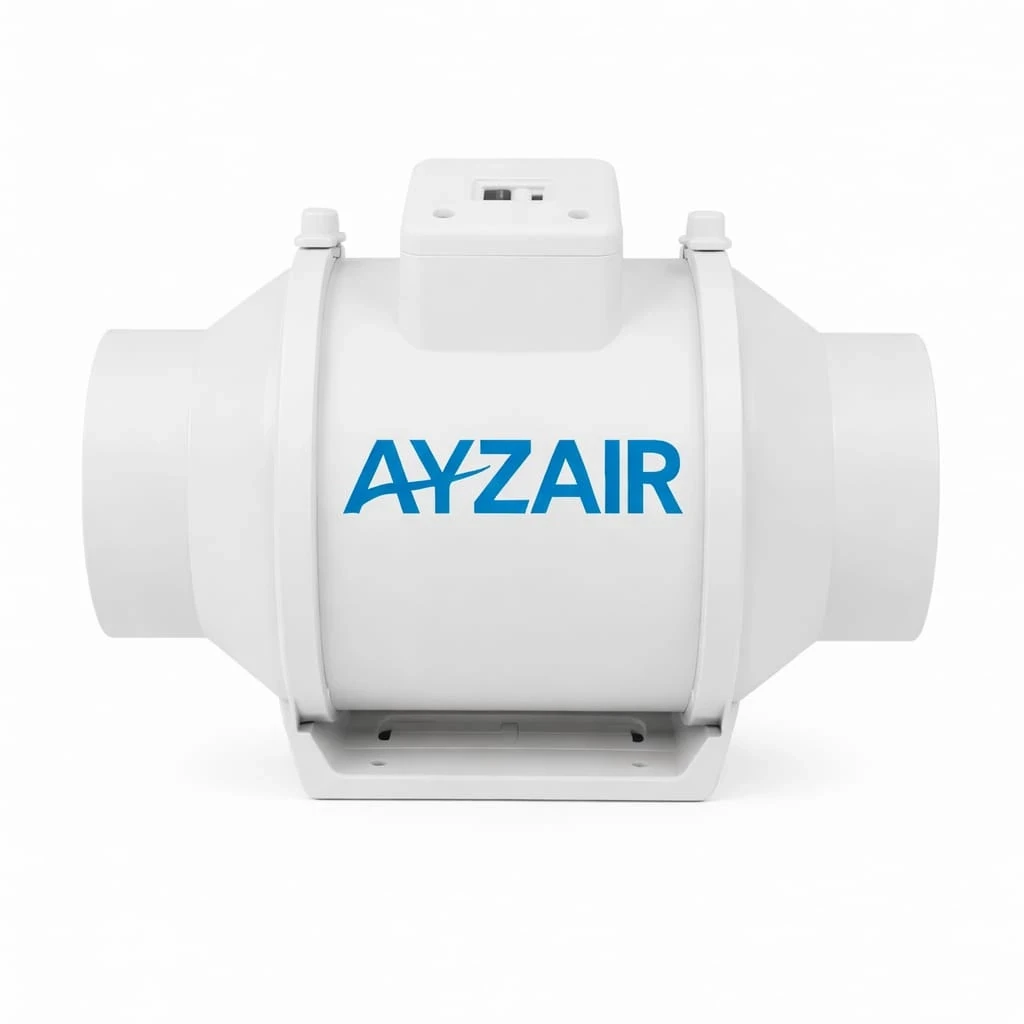
The Ayzair range is mixed-flow, which matters here. A mixed-flow impeller combines the pressure capability of a centrifugal fan with the air volume of an axial one, so it holds its airflow further up the pressure curve than a plain axial fan of the same diameter. That is why a Ø315 mixed-flow unit will still work on an eighteen-metre run where an axial fan of the same size would stall.
Each size is two-speed. The low setting is not a lesser product — it is the setting most installations should run at, with the high setting held in reserve for when the duct loads up or the design turns out to have been optimistic.
| Model | Duct | Air volume high / low | Static pressure high / low | Power high / low | Sound |
|---|---|---|---|---|---|
| AYZAIR-100 | Ø100 / 125 | 200 / 150 m³/h | 180 / 130 Pa | 28 / 25 W | 30 / 25 dB |
| AYZAIR-150 | Ø150 / 160 | 500 / 400 m³/h | 300 / 250 Pa | 50 / 40 W | 35 / 30 dB |
| AYZAIR-200 | Ø200 | 850 / 700 m³/h | 350 / 280 Pa | 70 / 60 W | 50 / 45 dB |
| AYZAIR-250 | Ø250 | 1,500 / 1,100 m³/h | 550 / 400 Pa | 170 / 130 W | 60 / 54 dB |
| AYZAIR-315 | Ø315 | 2,300 / 1,800 m³/h | 700 / 500 Pa | 320 / 230 W | 66 / 61 dB |
← Swipe the table sideways to see all columns
Worked example: a commercial kitchen extract
A kitchen hood needs 1,800 m³/h. The duct is Ø315, runs fourteen metres to the external wall, has three 90° bends, a grease filter at the hood and a weather louvre at the discharge.
Resistance adds up like this. Fourteen metres of straight duct at 2 Pa per metre is 28 Pa. Three bends at 20 Pa each is 60 Pa. The grease filter, clean, is 100 Pa. The louvre is 35 Pa. That is 223 Pa clean, and with a thirty per cent margin for a loaded filter and a dirty duct, call it 290 Pa.
So the requirement is 1,800 m³/h at roughly 290 Pa. The AYZAIR-315 delivers 1,800 m³/h at 500 Pa on its low setting, which clears 290 Pa comfortably and leaves the high setting — 2,300 m³/h at 700 Pa — in hand for when the filter loads. A Ø250 unit would have been the tempting cheaper choice, and at 1,500 m³/h maximum it would never have reached the required volume at all.
Three things that will catch you out
First, ambient temperature. A polypropylene-bodied fan is built for occupied spaces and normal plant rooms. If the fan sits somewhere genuinely hot — a roof void above a furnace, a duct carrying air off a process at 60 °C — a PP body is the wrong choice and we will say so rather than sell you one.
Second, supply frequency. Our motors are built for 50 Hz. On a 60 Hz supply a 50 Hz motor runs about twenty per cent faster, which raises airflow, current and noise together, and the bearings and impeller are not rated for it. The Philippines, most of the Americas, Saudi Arabia's western grid and parts of Japan are 60 Hz. Tell us the frequency and we will tell you honestly whether the fan suits.
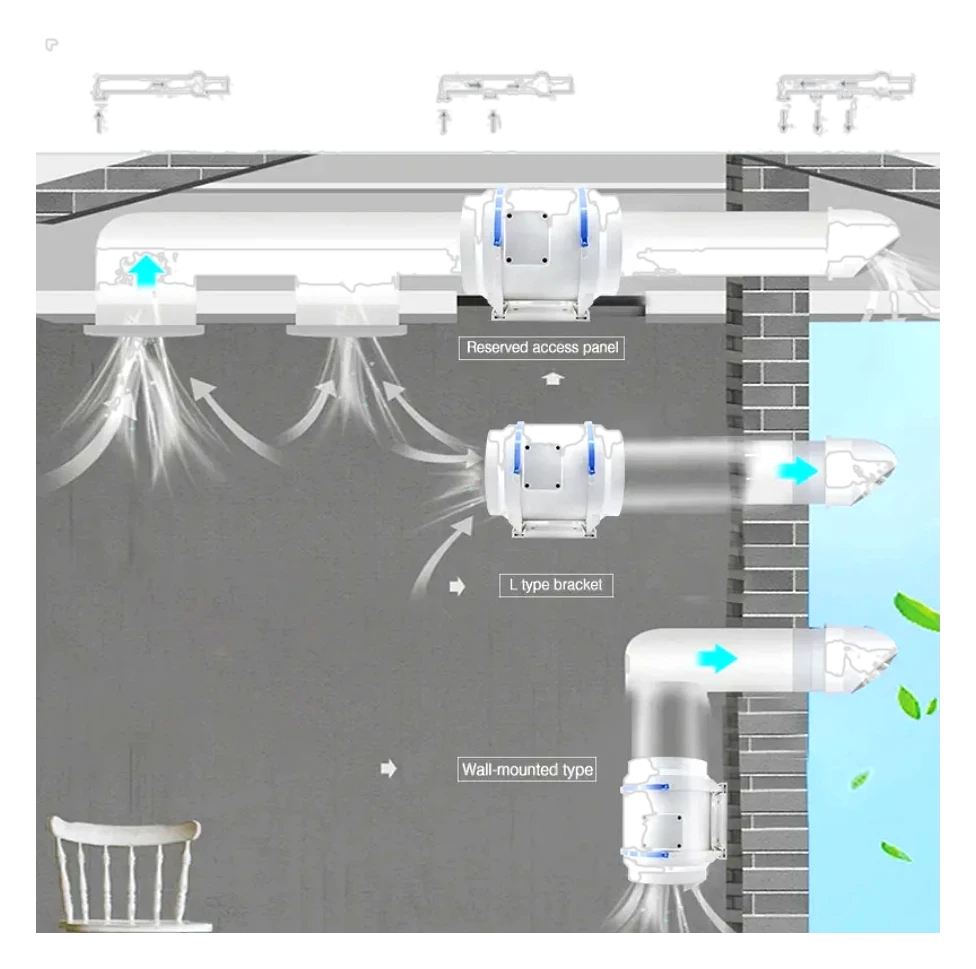
Third, inlet. An extract fan can only remove as much air as the space can let in. If a sealed room has 1,800 m³/h pulled out of it and no deliberate inlet path, the fan is working against the whole building and will deliver far less than its rating. Make-up air is part of the design, not an afterthought.
Send us the duct, not just the airflow
Tell us the duct diameter, the run length, how many bends, what filters are in the line and your supply voltage and frequency. An engineer will return the model, the operating point and the delivered airflow you will actually get — within one working day, at no cost.
Get a fan selection